

Gurugram, 3rd September 2026: Gurugram’s recurring flooding and waterlogging have raised questions over whether the city’s existing approach to infrastructure planning and funding is sufficient to deal with the scale of its rapid urban growth.
Despite investments in drains, pumps and diversion channels, several parts of Gurugram continue to face severe waterlogging during intense spells of rain. The issue was highlighted again on August 24, when around 80 mm of rainfall led to heavy waterlogging on Sohna Road and adjoining areas, with traffic coming to a standstill and several school buses getting stuck.
The problem is not limited to the absence of drainage infrastructure. Officials and experts have pointed to gaps in the existing network, blocked road gullies, disrupted natural water channels and the way the city has expanded over the years.
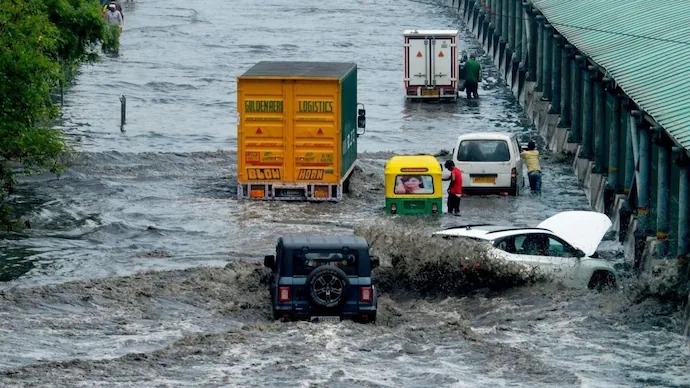 In one recent instance, the Gurugram Metropolitan Development Authority (GMDA) found that gaps in a gate at the junction of Leg 3 of the Badshahpur drain and Leg 4, the stormwater drain along the Southern Peripheral Road, along with a delay in fully closing the gate, contributed to flooding on Sohna Road. The Leg 4 drain had been constructed at a cost of more than Rs 100 crore to divert excess water.
At Subash Chowk, blocked road gullies prevented water from entering the drainage system. The master stormwater drain also takes a sharp turn because of an underpass, creating another bottleneck for water movement, according to the report.
The recurring flooding has also prompted the Municipal Corporation of Gurugram (MCG) to undertake catchment and drain mapping in areas including Subash Chowk, internal sectors and licensed colonies. The exercise is aimed at understanding how rainwater moves through the drainage network and identifying locations where drains require repairs or additional capacity.
The MCG is also working on a simulation model to identify drainage bottlenecks. Officials are considering measures including rainwater harvesting, groundwater recharge, injection wells and additional stormwater lines in narrow lanes and low-lying areas. Technical experts from IIT Gandhinagar are also being consulted, while 273 locations have been identified for rainwater harvesting systems.
However, the scale of the infrastructure required raises another question: how should Gurugram pay for it?
The city’s development has been driven significantly by private real estate investment, with large residential, commercial and office developments expanding across the region. At the same time, major infrastructure such as roads, drainage, sewage and water systems remains largely dependent on public agencies.
One possible approach is a greater role for public-private partnerships (PPPs), where developers contribute towards infrastructure that serves larger urban catchments instead of limiting infrastructure investments to individual projects.
Such a model could involve developers in a particular cluster contributing towards a common stormwater system or paying infrastructure impact charges linked to the additional pressure their projects place on existing roads, drainage and other civic infrastructure.
Another option is the use of municipal bonds to raise funds for large infrastructure projects.
Municipal bonds could potentially be used to finance projects such as stormwater drainage systems, detention ponds, sewage networks, water infrastructure and other long-term civic projects. However, such borrowing would require clearly defined projects, reliable revenue sources and systems to ensure that the funds are used for the intended infrastructure.
The funding question becomes more important as Gurugram continues to expand. The city’s flooding problem is not simply about adding more drains, but about ensuring that the different components of its drainage network work together.
Experts have also suggested that Gurugram needs to look beyond conventional concrete drainage infrastructure and restore natural water channels, ponds and other areas that can absorb and retain rainwater.
Urban planners have pointed towards a combination of so-called blue-green infrastructure and conventional drainage systems. This includes ponds, wetlands, rain gardens, bioswales and permeable surfaces that can allow more rainwater to be absorbed into the ground instead of immediately entering stormwater drains.
The approach is particularly relevant because rapid construction and concretisation have reduced the natural areas through which rainwater historically moved. Gurugram’s location below the Aravalli ridge also means that the city’s natural runoff patterns need to be considered while planning its drainage network.
The recent flooding has therefore exposed a larger infrastructure challenge for Gurugram. The city has continued to add roads, buildings and commercial developments, but its drainage and water-management systems have struggled to keep pace.
The answer may require a combination of public funding, private participation and long-term borrowing, along with better coordination between agencies such as the MCG and GMDA.
For Gurugram, the immediate challenge remains preventing roads and key corridors from turning into flood zones during heavy rain. But the longer-term issue is ensuring that future development does not repeat the same infrastructure gaps.
The city’s flooding crisis, therefore, is increasingly a question not only of drainage capacity but also of planning, coordination and how infrastructure for a rapidly expanding urban area is financed