

The Community Premium
Across global luxury residential markets—from established neighbourhoods in London and Singapore to prime enclaves in New York and Dubai—pricing in the most sought-after addresses
has long operated independently of city-wide averages. In these markets, value is shaped less by prevailing trends and more by scarcity, consistency, and the lived quality of the residential ecosystem. Select pockets of Pune are now beginning to exhibit similar characteristics, albeit at a different scale.
A quiet but decisive shift is underway in parts of Pune West. Prices in certain apartment developments and legacy villa societies have risen sharply—yet this movement does not mirror broader city trends or conventional market cycles. What is emerging instead is a community- driven price reset, where value is increasingly influenced by social composition, predictability of living, and long-term desirability, rather than by comparable launches or citywide averages.
Traditionally, Pune’s residential pricing followed predictable patterns—new supply, absorption, and incremental appreciation. That framework is now breaking down in a handful of micro- markets. In these locations, pricing behaviour reflects qualitative factors that are not easily captured by standard market metrics.
The most important of these is community as an asset. Increasingly, buyers—particularly end-users—are evaluating homes in the context of who their neighbours are and how the community is likely to evolve over time. Residential environments where occupants share broadly similar professional backgrounds, economic standing, and lifestyle expectations tend to offer greater predictability. This social coherence reduces friction, supports long-term upkeep, and contributes to sustained demand. Over time, such communities command a premium because they offer stability rather than novelty.
Closely linked to this is product homogeneity. Developments where units are largely similar in configuration, size, and ticket range create a more balanced ownership base. When residents have made comparable investment decisions, disparities within the community are minimised, resulting in a cohesive residential environment. This uniformity plays a quiet but meaningful role in preserving value.
Low density then acts as a reinforcing factor. Truly low-density residential developments— especially those offering open views, greenery, and privacy—have become increasingly scarce.
Once established, such environments limit future supply expansion and help preserve the character of the community. This scarcity lends resilience to pricing, particularly during periods when broader markets remain range-bound.
A further element is quality as a non-negotiable. In premium under-development projects and select completed developments, buyers are demonstrating a willingness to pay for execution certainty, superior specifications, and amenities that translate into tangible day-to-day benefits.
Thoughtful planning, large lifestyle amenity areas, and consistent construction standards now influence pricing more than headline narratives.
Importantly, this pattern is not unique to Pune. As seen globally, when community coherence, controlled density, and quality execution converge, pricing begins to decouple from broader market movements. Select addresses in Pune West are now exhibiting these same dynamics.
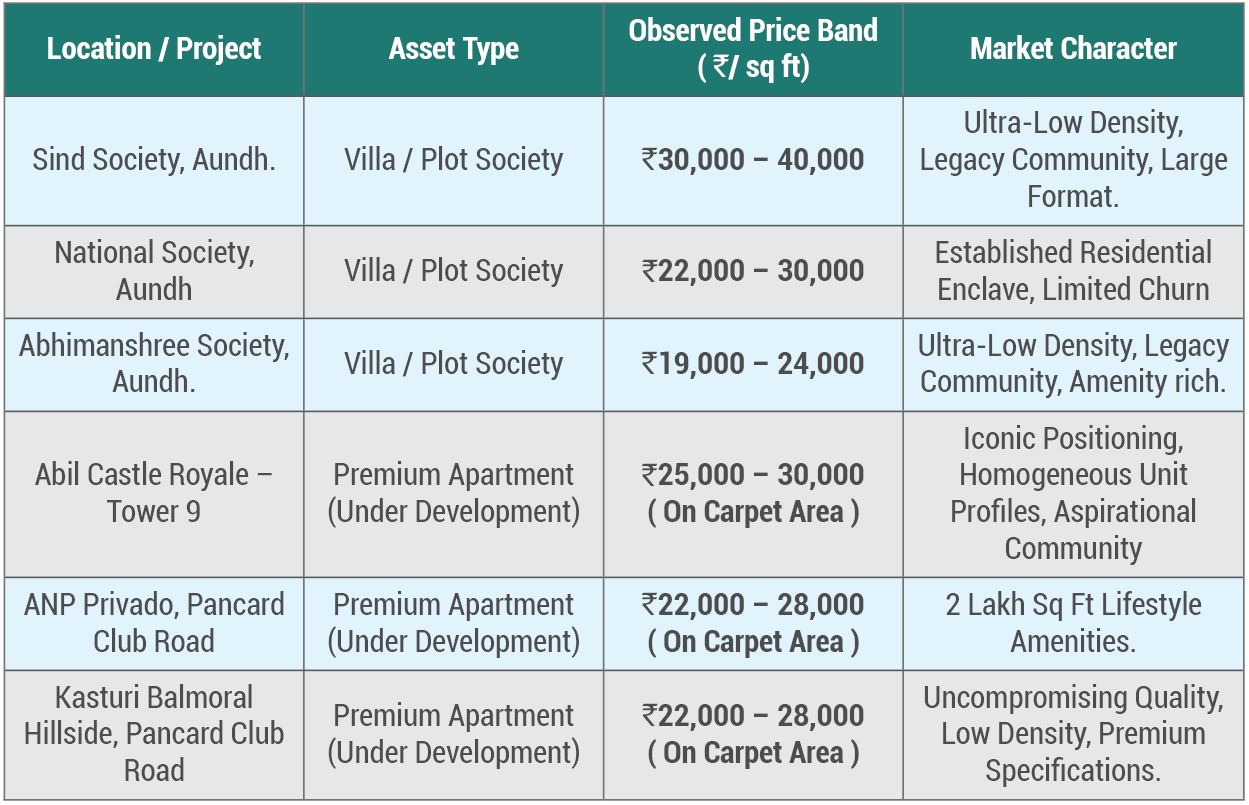
The following price bands reflect prevailing market observations across select Pune West communities. These are being observed across listings and recent negotiations; exact transacted rates vary by unit profile, floor, view, payment structure, and timing. Apartment prices mentioned below are indicative carpet-area values.

Tanuj Nagrani
Managing Partner – TSDN Realtors LLP
Vice President – Professional Realtors Of Pune Welfare Association
tanuj@tsdn.in